
Two hours with Korean tea ceremony
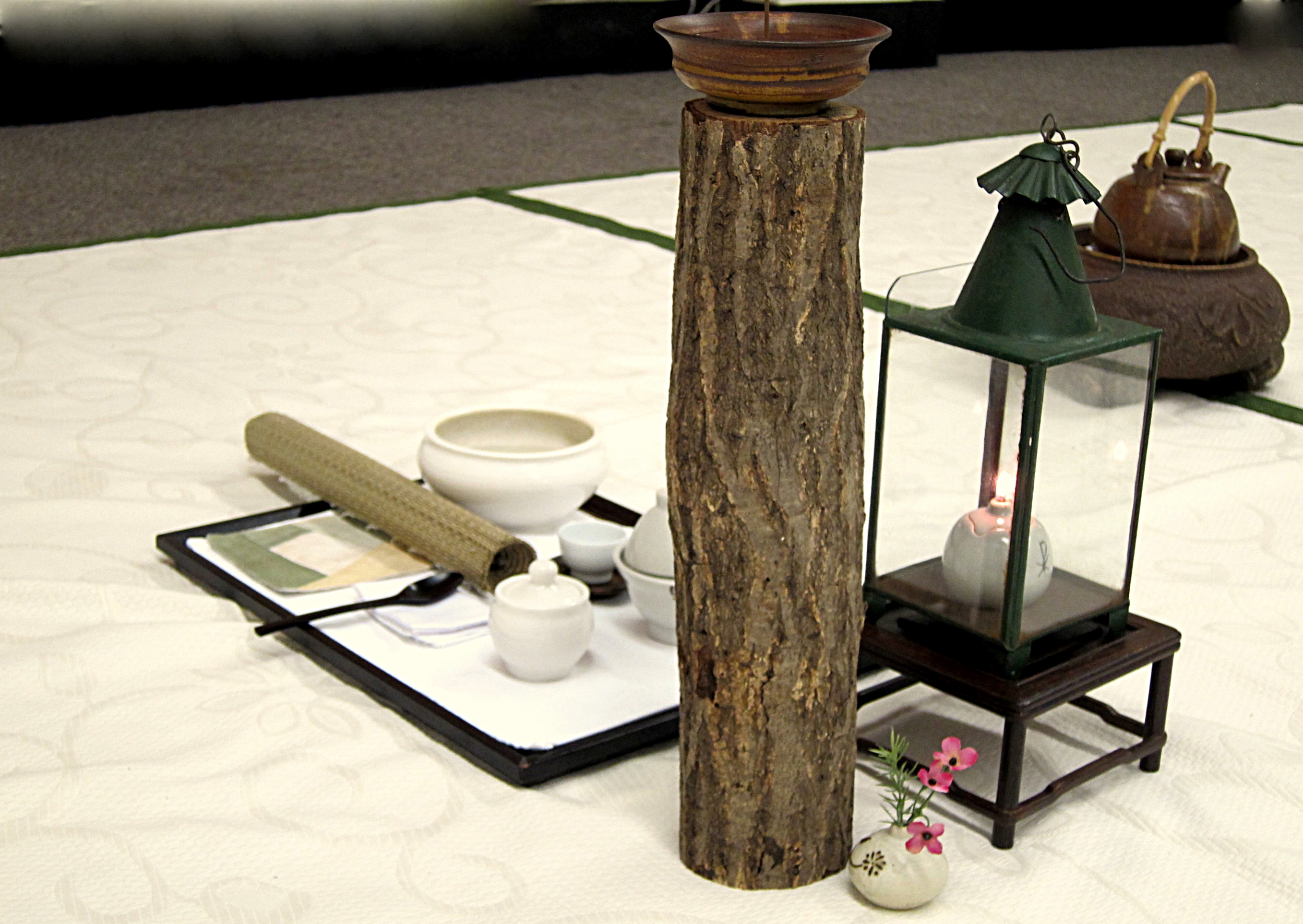
Between 4 and 6 PM today was the most interesting 2 hours I’ve had this week, and also the most effortless educational experience I’ve had in a long time. That’s how the Korean tea ceremony is meant to be, as I’ve learned: formal but relaxing, and ceremonious but natural. The rules are rather simple to get acquainted to, the movements make sense, and just watching made my mind feel nothing but calmly pleasant. The kind of pleasant feeling one would get gazing off into space alone, on a grassy hillside, on a cloudy day.
Now for the logistics. Inje University‘s Traditional Korean Tea Society (TKTS) gave a 2-hour presentation at Berkeley today as part of the “Dew of Wisdom” tour, Stanford and California State University got their tea before us. During the first 40 minutes, the students of TKTS demonstrated two types of tea ceremonies, both accompanied by the slow, deep, hardy rhythm of a 6-string zither 거문고 (geomungo).
The first type, 들차회 (deulchahue), is to be enjoyed with friends and relatives outdoor during spring and autumn. The setting is lighthearted, the purpose is to relax and to appreciate nature, the gathering comprises both men and women, and both hands are used during the preparation, serving, and tasting of tea.
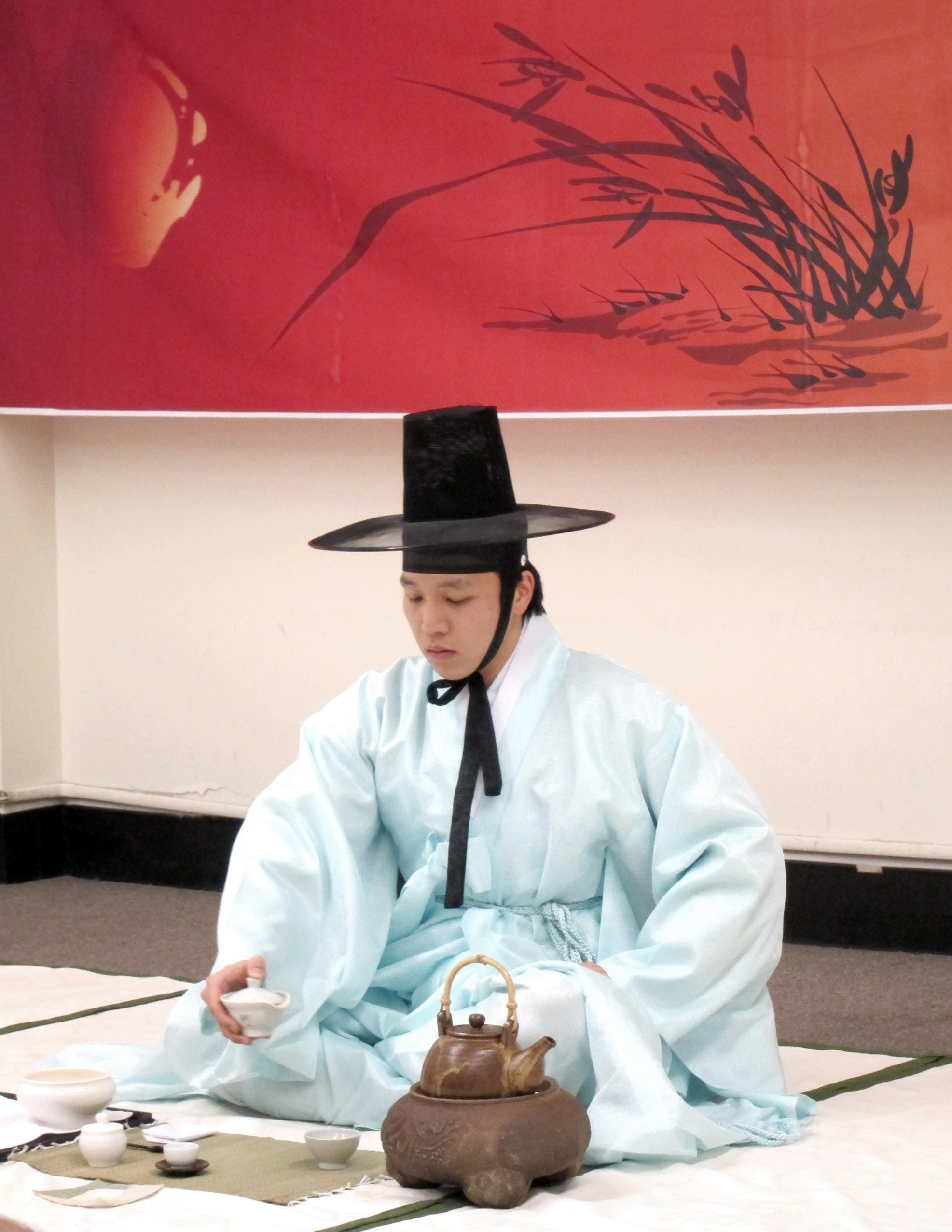
The second type, 선비다례 (seonbi darye), or “Scholar’s tea ceremony”, is practiced by noblemen to clear their mind and heighten their wisdom. The setting is dignified, and the man uses only his right hand to prepare and serve, signifying a more profound status than that in deulchahue. In both cases, the movements are fluid, slow, and steady.
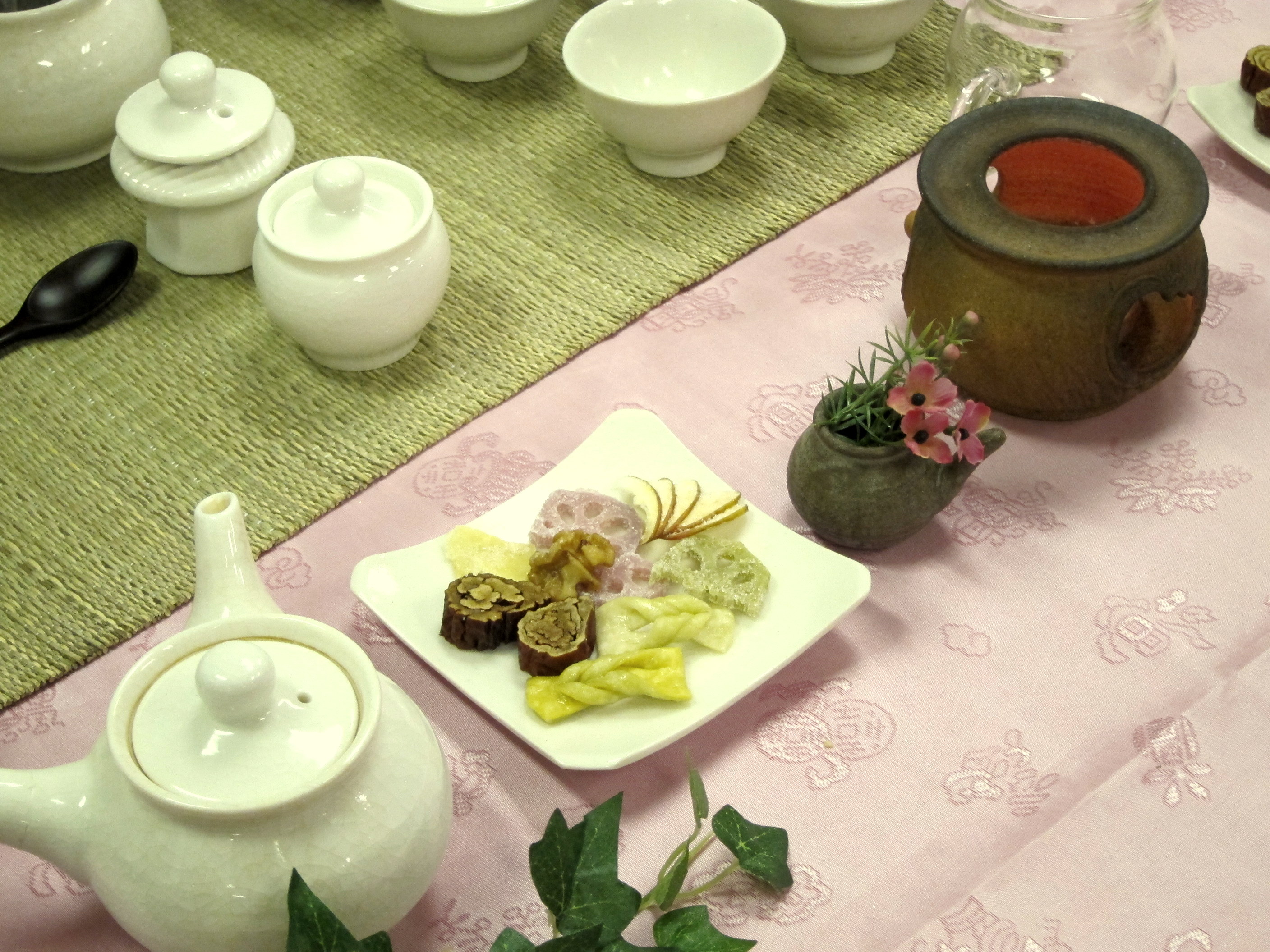
During the next 20 minutes, the guests were invited to taste green tea and yellow tea with a variety of 다식 (dasik), tea snack: candied lotus root, dried apple, dried jujube, and a kind of fried chips that I’d only seen in the drama Sungkyungkwan Scandal (성균관 스캔들). The green tea, unoxidized, looks and tastes clear with a very light herbal hint, like a white tea. The yellow tea, about 50% oxidized, similar to Tieguanyin, has an upfront sweetness and a deep citrine hue. Each batch of tea is brewed for about 2 minutes in 60-70°C water, as boiling water would induce a bitter taste.
After ample tea had been served, the guests came back to their seats for a brief presentation from Prof. Jaesup Pak, President of TKTS, on Korean tea production and ceremonial methods. I scribbled like mad, and here’s what little knowledge I’ve gained:
There are 3 major tea plantation regions in Korea: Boseong, Hadong, and Jeju. Boseong is the largest and most respected tea plantation, producing roughly 40% of Korean tea in 5.3 million square meter of hillside. Hadong, second in line, has produced wild tea for over 1200 years, and from its neighboring town Hwagae originated the Korean green tea culture. The tea here is grown completely natural on rocky 400-500 meter high mountainsides and harvested by hand. In contrast, Jeju‘s tea is grown with chemicals and fertilizers on rich volcanic island soil, plucked and chopped by machines, and heated and dried with steam.
Regardless of regions, tea leaves are plucked young between April and May because fully developed leaves are too coarse to use. Different grades of green tea are categorized based on their youngness. Ujeon (우전), the first grade, comes from the first harvest, which means it is picked by hand before April 20 for a delicate flavor. Sejak (새작), the second grade and the most popular type, is picked early May. Sejak means “Sparrow’s Tongue”, referring to the pointed shape of the young leaves at this stage. And finally, Jungjak (중작), the third grade, is picked mid May. The tea offered to the guests at the colloquium today was Sejak from Hadong.
The production process involves 6 steps: plucking, withering, parching, rolling, separating, and drying. Hand plucking tea is meticulous, even the most skilled women can pick only 2 kg per day. Within 24 hours after plucking, the leaves are left to wither in open air. Then they are tossed and stirred constantly in an iron cauldron over wood (traditionally) or gas fire at 200°C to soften. Rolling comes afterwards to intensify the taste, where the leaves are rubbed and rolled for 3-4 times on straw mats. This process makes the leaves stick together, thus separating must be done to help moisture evaporate from the leaves. Finally, the leaves are spread out and dried naturally on paper on a heated floor for 4-5 hours or overnight.
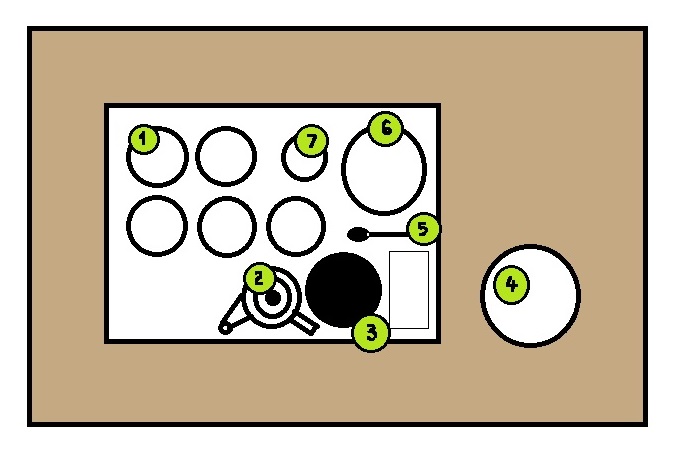
The teaware, or chagi (차기), are typically arranged as shown in the diagram above:
(1) Tea cups: usually 3 or 5 cups per set
(2) Tea pot for brewing. The teapot and kettle should be on the right side and closer to the host.
(3) Tea cup saucer, on which the filled tea cup is placed and received.
(4) Large bowl, into which the water used for warming the pot and cups is discarded.
(5) Tea spoon for taking tea leaves
(6) Smaller bowl for cooling the water and the tea, and for pouring the tea into the cups
(7) Tea caddy, which contains the tea leaves.
The small rectangle represents a napkin for tidiness.
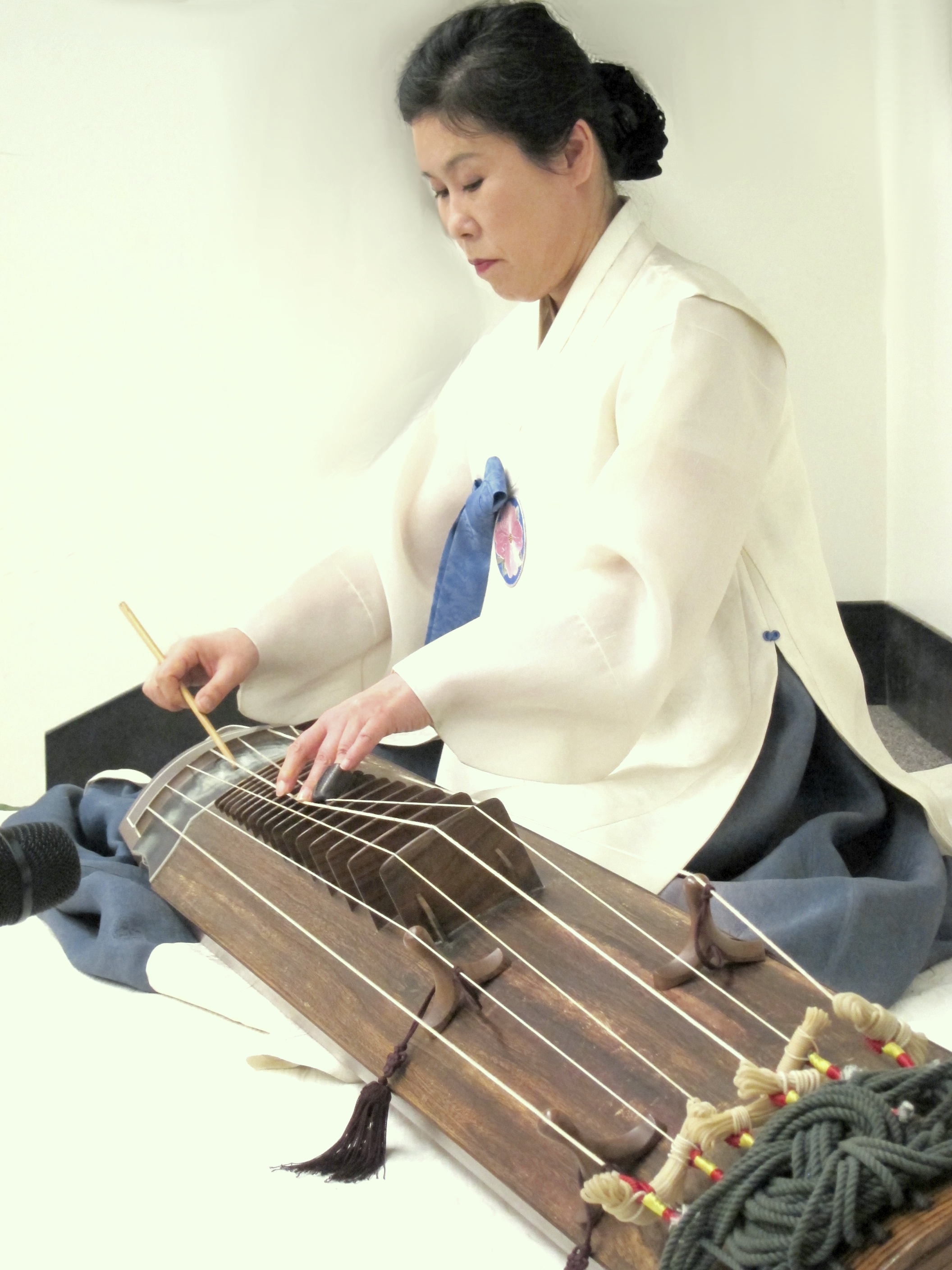
Professor Hyeyoung Shin (Chuncheon National University of Education) performing da-ak (다악, tea music) on a geomungo at the colloquium
The preparation after the arrangement begins with pouring hot water into the cooling bowl and letting it cool for under 2 minutes. Then the teapot, ready with 1-2 spoons of leaves, receives the cooled water; the lid is closed, and the leaves are brewed for a few minutes. While serving, the tea is poured into warmed cups from a high distance to create bubbles in the tea, which are believed to confer good luck. The receiver should hold the cup with the right hand and support it with the left hand, inhale the aroma, take a sip that is about one third of the cup, and drink 3 times from each cup served. I think I did it in more than 3 times… I was savoring the flavor a little too carefully.
At the end, we got to take our cups home as a souvenir. A cute little white tea cup to commemorate a sweet, delicate two-hour lesson. 🙂
This post also appears in Tea & Mai


Wow, very nice post, Mai! The video is super cool. Thanks for sharing. Now I miss being in school! :)…Oh and geomungo is interesting looking. I didn’t know the zither could have so few strings…darn, why did I pick đàn tranh 😛 (j/k…I still prefer the sound of the đàn tranh)
1Hehe thank you Oanh. It seems to me that the strings on the geomungo are thicker than the strings on đàn tranh, and they’re made of silk instead of metal, so the sound is deeper, like dripping water in a cave. The sound of đàn tranh is more like running water in a spring, which I also prefer. 😛 I wanted to take video of the seonbidarye too, but my memory card ran out of space. 😛
2This is exactly what I was looking for. Thanks for the useful information.
3This was an excellent read. Very thorough and well-researched.
4You are a very capable person!
5Hmm it seems like your website ate my first comment (it was super long) so I guess I’ll just sum it up what I had written and say, I’m thoroughly enjoying your blog. I as well am an aspiring blog blogger but I’m still new to the whole thing. Do you have any tips for first-time blog writers? I’d genuinely appreciate it.
6I really enjoy looking at on this web site, it contains wonderful blog posts. “Sometime they’ll give a war and nobody will come.” by Carl Sandburg.
7I have read some just right stuff here. Certainly value bookmarking for revisiting. I wonder how a lot attempt you set to create such a great informative web site.
8Write more, thats all I have to say. Literally, it seems as though you relied on the video to make your point. You obviously know what youre talking about, why throw away your intelligence on just posting videos to your weblog when you could be giving us something enlightening to read?
9Hello there, just become aware of your blog thru Google, and located that it’s really informative. I am gonna watch out for brussels. I will appreciate in the event you continue this in future. Many other folks might be benefited from your writing. Cheers!
10Thank you for another magnificent post. Where else could anyone get that type of information in such an ideal way of writing? I have a presentation next week, and I am on the look for such information.
11This is a very good tips especially to those new to blogosphere, brief and accurate information… Thanks for sharing this one. A must read article.
12I have read a few good stuff here. Certainly worth bookmarking for revisiting. I surprise how much effort you put to create such a magnificent informative website.
13After all, what a great site and informative posts, I will upload inbound link – bookmark this web site? Regards, Reader.
14I have recently started a website, the info you offer on this website has helped me greatly. Thanks for all of your time & work.
15Good website! I really love how it is simple on my eyes and the data are well written. I am wondering how I could be notified when a new post has been made. I have subscribed to your RSS which must do the trick! Have a nice day!
16I was recommended this web site via my cousin. I am not certain whether or not this put up is written by means of him as nobody else recognise such distinctive about my problem. You are wonderful! Thank you!
17I reckon something really special in this internet site.
18Thanks for the sensible critique. Me and my neighbor were just preparing to do a little research about this. We got a grab a book from our local library but I think I learned more from this post. I’m very glad to see such great information being shared freely out there.
19Some genuinely superb articles on this internet site, appreciate it for contribution. “We are always in search of the redeeming formula, the crystallizing thought.” by Etty Hillesum.
20Very nice post. I just stumbled upon your blog and wanted to say that I’ve really enjoyed browsing your blog posts. In any case I’ll be subscribing to your rss feed and I hope you write again soon!
21I like forgathering utile info, this post has got me even more info! .
22Lovely just what I was looking for.Thanks to the author for taking his time on this one.
23Have you ever considered creating an e-book or guest authoring on other blogs? I have a blog based upon on the same topics you discuss and would really like to have you share some stories/information. I know my audience would value your work. If you’re even remotely interested, feel free to shoot me an e-mail.
24Hello! Do you know if they make any plugins to help with SEO? I’m trying to get my blog to rank for some targeted keywords but I’m not seeing very good results. If you know of any please share. Appreciate it!
25Real good info can be found on web site.
26You got a very wonderful website, Glad I noticed it through yahoo.
27This really answered my problem, thank you!
28Whoa! This blog looks just like my old one! It’s on a entirely different subject but it has pretty much the same layout and design. Outstanding choice of colors!
29I got what you mean , appreciate it for putting up.Woh I am delighted to find this website through google.
30I got what you intend, thanks for putting up.Woh I am pleased to find this website through google. “It is a very hard undertaking to seek to please everybody.” by Publilius Syrus.
31Thank you for helping out, superb info. “In case of dissension, never dare to judge till you’ve heard the other side.” by Euripides.
32It is really a nice and helpful piece of information. I am glad that you shared this useful info with us. Please keep us up to date like this. Thanks for sharing.
33Just what I was looking for, thanks for posting.
34My programmer is trying to convince me to move to .net from PHP. I have always disliked the idea because of the expenses. But he’s tryiong none the less. I’ve been using WordPress on several websites for about a year and am worried about switching to another platform. I have heard very good things about blogengine.net. Is there a way I can transfer all my wordpress posts into it? Any help would be really appreciated!
35F*ckin’ amazing things here. I’m very satisfied to peer your article. Thanks so much and i am looking forward to touch you. Will you kindly drop me a mail?
36